
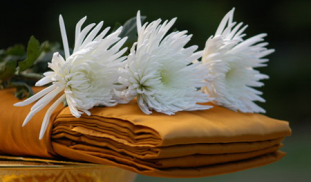
"Immovable, O King, is the State of renunciation, glorious and most exalted the condition of being a member of the order of the Blessed One."
(Milindapañha, part IV - The Dilemmas, chapter 3 - Why do members of the Order accept reverence?)
It is possible to ordain and train as a Buddhist nun at Dhammanikhom. The ordination process is gradual and it takes time and patience to develop along this path.
Nuns who have already been ordained in any form or at any level and are considering training at Dhammanikhom are welcome to contact the nunnery and address their inquiry to the abbess or spiritual director. Each case will be considered individually. In all cases, permission from the preceptor or existing independence is required. It is generally recommended to register for a meditation course first.
Getting to know each other - Introductory Phase
Because we are a nunnery and also a meditation center in the Vipassana tradition of the Most Venerable Phra Ajarn Tong Sirimangalo (Phra Ajarn Tong Sirimangalo) from Thailand, interested candidates must first complete the basic and advanced courses as well as several retreats in this tradition (including at Dhammanikhom) before the first stage of ordination as a “Maechee” can be considered.
In this way, one gets to know the nunnery as a meditator and after the basic course it is
possible to combine the courses with nunnery stays or practice and merit weeks. This gives
an initial insight into the monastic routine and allows one to get to know the community and
standards of practice to see for oneself if there is still interest. At the same time, in this
introductory phase, which can extend over a longer period of time, certain worldly things can
gradually become clear and crystalize and the desire to ordain can be examined.
Our revered teacher, the Venerable Phra Ajarn Tong Sirimangalo, has often highlighted that it is
important to first ordain within the heart (i.e. to purify the heart through meditation) and then
when indicated pursue the religious path as a monk or nun.
Ordaining as a Buddhist nun requires a great deal of commitment and dedication. And
depending on the level of ordination, the standard of the monastic training rules (Vinaya)
increases.
In principle, it is also possible for interested women from abroad to ordain here. However,
individual visa issues must be clarified during the introductory phase. For longer-term visa
applications, learning German (B-1 Level) is essential.
Ordination as aspirant (Maechee)
(in other traditions referred to as Anagarika)
Those who have already attended several courses at Dhammanikhom and have also been here as a nunnery guest, have the opportunity to express their wish for ordination and discuss it with the abbess/leading Bhikkhuni.
It is then necessary to complete a three-month trial period. During this time the wish for Maechee training can be formally expressed.
After that, it is normally necessary to leave the nunnery again and then, if the Bhikkhuni Sangha considers the candidate suitable and a place is available, receive an invitation.
Ordination as a Maechee is the first step towards full ordination as a Bhikkhuni. A Maechee, like meditators, observes the 8 Buddhist Precepts plus the 75 Sekhiyas (rules of conduct), shaves her head, wears white robes, and lives permanently in the nunnery. She is, however, still financially responsible and must pay for her own health and liability insurances, travel costs and personal expenses.
As a Maechee one experiences for the first time what it means to not just be a guest in the nunnery, but rather to dedicate oneself full time to the Dhamma and monastic life. One receives basic Vinaya training and practices living in robes.
A Maechee supports the nunnery and the fully ordained nuns in all aspects of the kitchen, house, and garden. This mainly includes kitchen work including cooking, cleaning, and clearing away, gardening, and accompanying or driving the nuns to appointments and invitations. A Maechee is still allowed to drive a car and do shopping for the nunnery. She also provides occasional support in the preparation and implementation of religious tasks and meditation courses.
This period lasts 1-2 years (longer if necessary).
In principle, it is also possible for suitable candidates – as is customary in Thailand – to temporarily take this consecration. In this case, the minimum duration is two weeks, and a long-term preparation is not necessary. A temporary dedication cannot, however, spontaneously turn into a long-term dedication.
Samaneri-Ordination
After a minimum of 1-2 years (longer if necessary) as a Maechee, it is possible to express the intention to move into homelessness and ordain as a novice. Ordination is performed with the lineage of the Sinhalese Bhikkhuni Sangha, either in Sri Lanka or in Dhammanikhom.
Samaneris keep the 10 Buddhist Precepts and 75 Sekhiyas and wear the orange robes like the Bhikkhunis (without Sanghati). It is required that the Samaneri training (minimum 2-3 years, longer if necessary) will be completed at Dhammanikhom. This may include temporary stays at the parent monasteries/ nunneries in Thailand and/or Sri Lanka or other befriended nunneries.
This step involves a drastic change because as a Samaneri one is truly homeless and lives in dependence on alms. One eats from the alms bowl and is dependent on requisites being offered by
the lay community. One cannot buy the robes for oneself in a shop… ; )
From this point onwards, the monastery bears the cost of health insurance. For this reason, this step is only possible if the monastery has the financial means to do it. Traveling (e.g. to
the parents) is possible if there is an invitation, the costs are covered, and the leading Bhikkhuni gives her consent.
A Samaneri may drive a car if necessary, but will no longer do shopping for the nunnery. If there are no lay people or Maechees on site, she may cook from the available food and offer it to the Bhikkhuni Sangha. A Samaneri may help herself to the defined nunnery supplies without it needing to be offered in both hands.
She supports the Bhikkhuni-Sangha wherever possible and the practice of respectful relationsships within the Sangha and the performance of upaṭṭhāka-dueties is an important aspect of the training.
Furthermore she continues to help with all tasks in the nunnery, as long as her training rules allow it (e.g., a Samaneri should no longer perform certain gardening tasks). And, of course, she gradually learns to fulfill her religious duties and is increasingly introduced to the corresponding tasks, supporting the Bhikkhuni Sangha in this.
Also within this ordination level, one is gradually trained in the Dhamma and Vinaya, especially if the wish for higher ordination as a Bhikkhuni is present.
Bhikkhuni-Ordination
After 2-3 years (longer if necessary) as a Samaneri, one can make the request for Bhikkhuni ordination. This is carried out with the lineage of the Singhalese Bhikkhuni Sangha, in Sri Lanka or in Dhammanikhom.
It is assumed that one will remain in the monastery another 3-5 years for further education and
Bhikkhuni training before one is granted independence and can move to another place with the
permission and blessing of the abbess and the Bhikkhuni Sangha – should this be desired.
During this time there might be temporary stays in befriended nunneries or meditation centers in Germany or abroad in order to gain experiences outside of the familiar and protected environment.
Depending on the situation and conditions, candidates from abroad may be encouraged and supported to return to their home country to serve and teach the Dhamma there. German Bhikkhunis will be encouraged to return and support the local Sangha in their home country.